The industrial wastewater, which must be cooled before discharge, can be "monetized" by converting its heat value into usable process heat through recovery and upgrading, thereby reducing the cost of emission cooling and primary energy consumption.



The industrial wastewater, which must be cooled before discharge, can be "monetized" by converting its heat value into usable process heat through recovery and upgrading, thereby reducing the cost of emission cooling and primary energy consumption.

Currently, most industrial wastewater is discharged at a certain temperature and must be cooled to meet emission standards before being released. The cooling process essentially involves discarding useful heat, resulting in significant energy waste. At the same time, the temperature and flow rate of wastewater often fluctuate with production conditions, making traditional waste heat recovery methods inadequate and difficult to achieve stable heat capture and utilization. Furthermore, production processes still rely heavily on steam, electric heating, and other methods to provide process heat, which not only incurs high energy consumption costs but also faces significant pressure from carbon emission control regulations. Additionally, the wastewater medium may have issues such as scaling, corrosion, and excessive pollutants, posing stringent requirements on the adaptability, stability, and safety of the waste heat recovery system.
System objectives:
While meeting the emission/reuse temperature requirements, maximize the recovery of waste water heat and enhance thermal quality, producing stable and controllable hot water/steam for process use.
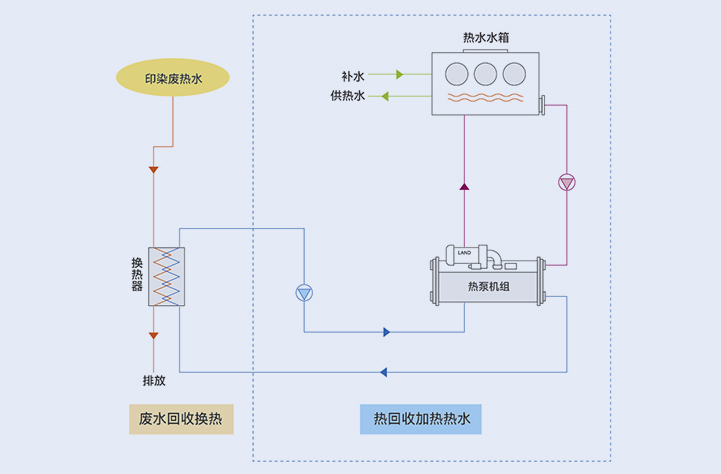
Specific plan
1. Pre-treatment and heat exchange
In the wastewater collection section or key hot wastewater branches, dedicated waste heat recovery devices are installed, accompanied by pre-treatment processes such as filtration and heat exchange. Necessary anti-scaling and anti-corrosion measures are also taken to ensure medium cleanliness and system safety.
2. Heat upgrading and quality improvement
By utilizing the Land heat pump system, we can enhance and elevate the temperature of recovered low-grade waste heat, efficiently producing high-temperature hot water or steam that meets process requirements, thereby enhancing the value of heat utilization.
3. Heat side optimization and intelligent control
The recovered heat is preferentially supplied to stable hot spots such as process preheating and constant temperature maintenance. To address fluctuations in wastewater conditions, a thermal storage device is configured when necessary to balance heat supply and demand, ensuring stable temperature at the heat-using end. A linkage control system is established to automatically adjust system operating parameters in real time based on changes in wastewater temperature and flow rate, as well as production heat demand, ensuring long-term sustainable operation of the system and strictly controlling safety boundaries.
Yantai Land Air Conditioning Industry Co., Ltd.
No. 3, Land Road, Laishan District, Yantai City, Shandong Province
400-6582531
Follow The Platform

WeChat Official Account

Video Channel

Douyin account