Recover and upgrade the waste heat from process cooling water, convert it into process heat, and achieve both cooling and heating simultaneously.



Recover and upgrade the waste heat from process cooling water, convert it into process heat, and achieve both cooling and heating simultaneously.

A large amount of heat generated by process equipment is dissipated through the cooling water system, resulting in a waste of thermal energy. Meanwhile, the production side still needs to purchase additional steam or consume electricity for heating, creating a contradiction of "losing heat while buying heat," which increases production costs. Additionally, the cooling system operates at high load for extended periods, leading to high energy consumption, especially during summer and high-load periods. Furthermore, fluctuations in the temperature of process heat affect product quality consistency and production stability.
System objective:
Without disrupting the original production process, recover waste heat from cooling water and enhance its quality, producing high-grade heat sources that meet process temperature requirements; simultaneously, reduce the load on the cooling system to achieve cost reduction, carbon reduction, and stable temperature control.
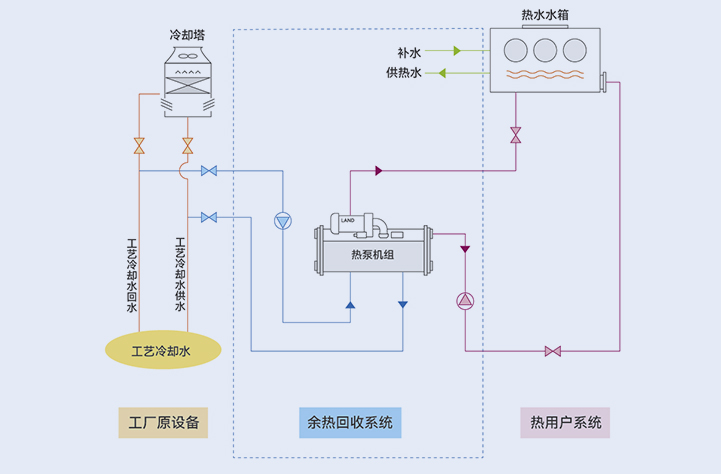
Specific plan
1. Circuit modification and pretreatment
Add a waste heat recovery device to the existing process cooling water circuit, and equip it with pre-treatment equipment to ensure that the heat extraction process does not affect the original function of the cooling water system, while also ensuring stable operation of subsequent equipment.
2. Quality improvement and transformation of Land heat pump
The Land heat pump system produces high-temperature hot water or steam that meets the thermal requirements of industrial processes, achieving the conversion of low-grade waste heat into high-grade heat sources.
3. Heat side matching and stable energy supply
The upgraded high-temperature heat source is connected to various hot spots in the production process, achieving precise matching of thermal quality through dedicated heat exchangers, buffer water tanks, and other equipment. This effectively mitigates temperature fluctuations and ensures stable heat utilization for the process. The system adjusts key parameters such as water temperature and flow rate in real-time according to changes in production load and fluctuations in heat demand. At the same time, it can be combined with time-of-use electricity pricing policies to optimize equipment operation periods and further reduce operating costs.
Yantai Land Air Conditioning Industry Co., Ltd.
No. 3, Land Road, Laishan District, Yantai City, Shandong Province
400-6582531
Follow The Platform

WeChat Official Account

Video Channel

Douyin account