Recover the heat from boiler flue gas emissions and upgrade it into a usable heat source, using the heat from the flue gas to support process heat, thereby further reducing fuel consumption and emissions.



Recover the heat from boiler flue gas emissions and upgrade it into a usable heat source, using the heat from the flue gas to support process heat, thereby further reducing fuel consumption and emissions.

Currently, the exhaust temperature of boiler flue gas is high, but traditional treatment methods only utilize simple economizers for heat exchange or direct emission, resulting in extremely low heat utilization efficiency and severe energy waste. At the same time, the high demand for steam/hot water on the process side leads to long-term high-load operation of the boiler, which not only maintains high fuel costs but also faces significant pressure on carbon emission control. Moreover, conventional heat exchange recovery methods are limited by temperature difference conditions and operating conditions, resulting in insufficient heat quality recovery, making it difficult to directly match the higher temperature heat demand on the process side, and thus the recovery value is not fully utilized.
System objective:
Without compromising the safety and stable operation of the boiler, enhance the depth of flue gas waste heat recovery, feed it to the process end, reduce boiler fuel consumption, lower carbon emissions, and stabilize heat supply.
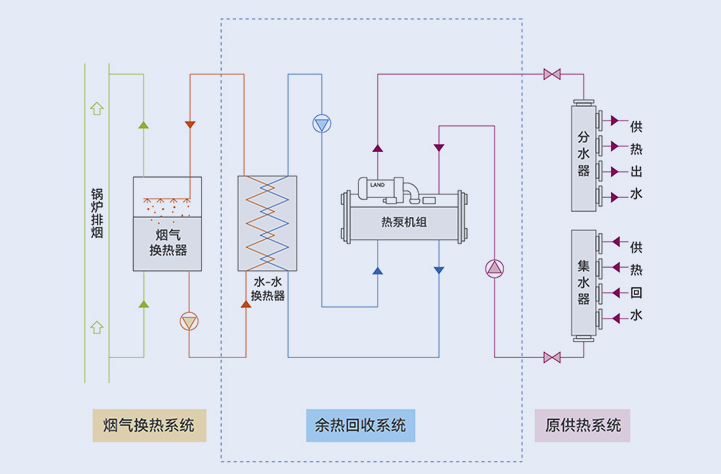
Specific plan
1. Heat exchange on the flue gas side
A waste heat recovery heat exchanger is deployed on the flue gas side to efficiently capture the sensible and latent heat in the flue gas and transfer the heat to the intermediate circulating water circuit, completing the preliminary heat recovery.
2. Quality improvement and upgrading of Land heat pump
The Land heat pump system is connected to intermediate circulating water for heat upgrading, converting low-grade recovered heat into high-temperature hot water or steam, directly meeting the heat demand for process production and preheating.
3. Intelligent load regulation and linkage
The intelligent control system monitors and adjusts key operating parameters on the flue gas side in real-time, while achieving stable supply and precise on-demand adjustment of heat output. It optimizes overall energy use by establishing a production load linkage mechanism, synchronizing and coordinating the operation strategies of boilers and heat pumps, optimizing the overall energy use sequence, and achieving efficient energy utilization across the entire system.
Yantai Land Air Conditioning Industry Co., Ltd.
No. 3, Land Road, Laishan District, Yantai City, Shandong Province
400-6582531
Follow The Platform

WeChat Official Account

Video Channel

Douyin account