Solution

Solution

Energy tower integrated cold and warm water supply system

For scenarios where cold, heat, and domestic hot water coexist in hospitals, hotels, schools, industrial parks, etc., we utilize refrigeration and heat recovery for heating and hot water supply, achieving energy station integration and energy synergy.


Current Situation / Pain Point

Decentralized construction leads to mutual energy waste

Decentralized construction leads to mutual energy waste

Scenarios such as hospitals, hotels, schools, and industrial parks often have simultaneous demands for heating, cooling, domestic hot water (or even process hot water), and these demands are off-peak in terms of time of day/season. The traditional approach involves the decentralized construction of "chiller + boiler/water heater", resulting in fragmented systems and mutual energy waste (refrigeration waste heat is discarded, and hot water is produced separately by starting a new boiler).

Solution

System Objective:
Convert the heat from the cold end into hot water and heating sources, achieving combined cooling and heating supply as well as energy recovery.

Solution

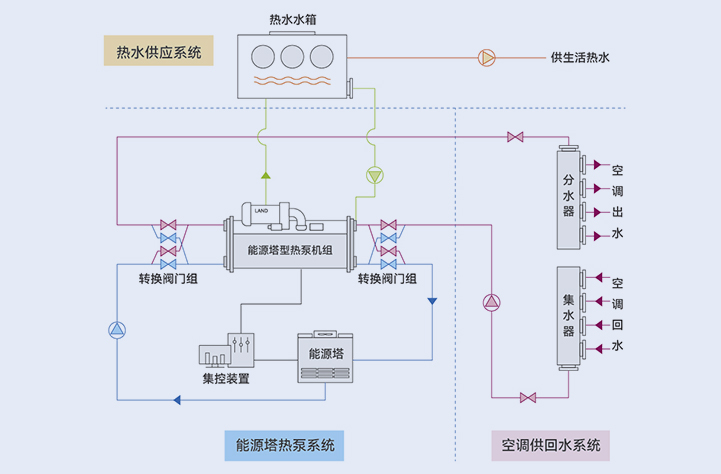
Integrated energy station architecture


The energy tower, serving as an outdoor heat exchanger, can assume the role of a heat source/sink in different seasons. The main unit adopts a switchable operation mode:
Cooling mode: Provides cooling to the building while efficiently transferring the waste heat generated during the cooling process to the energy tower;
Heating mode: Extract heat from the energy tower side and supply heat to the heat network to meet the heating demand in winter;
Heat recovery mode: When there is a demand for hot water, the system automatically prioritizes the recovery of waste heat discharged from the refrigeration side for the production of domestic hot water, without requiring additional energy consumption. This achieves bidirectional energy synergy of "using cold to generate heat and using heat to generate cold", maximizing energy loss reduction.


Integrated supply of three networks


A three-network linkage system is constructed through heat exchangers, three-way valve groups, and water tanks to achieve priority control and stable supply of three types of demands. The control core is to first meet rigid demands and then optimize the allocation of heating/cooling energy.


Operation and maintenance, and reliability


The system can monitor energy consumption data and equipment operating status in real-time, facilitating rapid energy consumption diagnosis and optimization adjustments, as well as precise control of operating costs.