Convert the low-grade waste heat that "must be cooled/discharged" in industrial production into a stable and dispatchable regional heating source, and achieve "undisturbed operation on the industrial side and stable output on the heat network side".



Convert the low-grade waste heat that "must be cooled/discharged" in industrial production into a stable and dispatchable regional heating source, and achieve "undisturbed operation on the industrial side and stable output on the heat network side".

Industrial parks and factories generate a significant amount of low-grade waste heat that needs to be cooled or discharged, but it is often lost through cooling towers or direct discharge systems without being effectively utilized, resulting in a considerable waste of energy resources. Surrounding buildings still rely on boilers or single heat sources for heating, facing pressure from energy consumption, emissions, fuel fluctuations, and policies.

The heating of buildings surrounding the waste heat emission sources still primarily relies on traditional boilers or single heat source models. This model not only has high energy consumption and large emissions of pollutants, but also faces cost uncertainty due to fluctuations in fuel prices. At the same time, it is not sustainable enough to align with the policy direction of the "dual carbon" goals and is under increasing pressure from stricter environmental protection policies.

The core challenges of industrial waste heat recovery for heating lie in three aspects: Firstly, there are natural fluctuations in the waste heat source on the industrial side, leading to insufficient output stability; secondly, the demand on the heating side exhibits strong seasonality, with significant differences between peak and off-peak periods; thirdly, the industrial production system and the regional heating system must be physically isolated safely, while addressing key issues such as stable scheduling and delineation of responsibility boundaries between the two systems to avoid mutual interference.
System objective:
To efficiently convert industrial low-grade waste heat into stable heating capacity that can be grid-connected and dispatched, while considering both industrial production safety and regional heating reliability, achieving a win-win situation of efficient energy utilization and environmental protection and emission reduction.
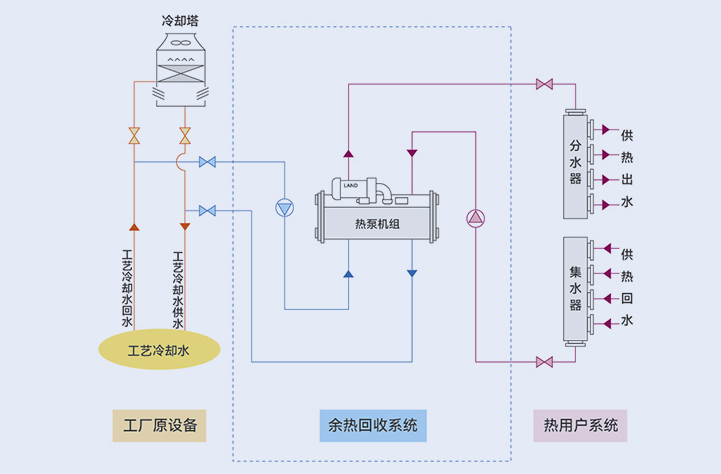
Heat source side: Implement "isolation" for heat extraction to ensure safety on the industrial side
Heat exchangers are installed on the industrial circulating water and process return water sides, which are physically isolated from the production system to ensure that the original process is not affected.
Adopting a hierarchical utilization strategy, when the quality of waste heat is high, high-level heat is first extracted through direct heat exchange, and then low-level waste heat is recovered using a heat pump to maximize utilization.
Energy station: Operate in a "scheduling" manner to balance supply and demand fluctuations
Adopting a parallel design with multiple heat pumps, the system can automatically achieve unit start-stop and variable frequency adjustment according to real-time heating load, flexibly matching changes in heating demand. At the same time, according to the actual needs of the project, a buffer water tank or thermal storage device can be selected to achieve "peak shaving and valley filling" of heating load, isolating fluctuations in waste heat from the industrial side within the energy station, ensuring that the heat source output to the heat network side remains stable and controllable.
Control and operation and maintenance: "Intelligentization" of the entire chain to enhance reliability
Build a full-chain linkage control system of "heat source - heat pump - heat network". The Landcloud platform relies on IoT technology to achieve functions such as equipment monitoring and data collection, supporting unattended operation and GIS integration; the operation and maintenance management software possesses core capabilities such as remote control and fault warning, which can improve operation and maintenance efficiency, ensure stable energy supply, reduce energy consumption, support energy station-level contract energy management, and ensure that the heat extraction process does not affect industrial production safety.
Yantai Land Air Conditioning Industry Co., Ltd.
No. 3, Land Road, Laishan District, Yantai City, Shandong Province
400-6582531
Follow The Platform

WeChat Official Account

Video Channel
Douyin account