Recover the waste heat from the low-temperature end of the process and utilize it at the heating end, thereby achieving steam reduction, reduced cooling load, and improved system energy efficiency.



Recover the waste heat from the low-temperature end of the process and utilize it at the heating end, thereby achieving steam reduction, reduced cooling load, and improved system energy efficiency.

In low-temperature and high-humidity environments, air source heat pumps are prone to issues such as heat exchanger frosting, significant energy loss during defrosting, and a steep decline in heating capacity. Some models even face hidden dangers such as difficulty starting at low temperatures and compressor overload protection. This directly leads to the typical contradiction in northern heating where "the equipment is the hardest to use when heat is most needed." At the same time, issues such as poor compatibility with traditional terminals, high renovation costs, and insufficient operational stability further hinder the efficient implementation of regional heating. Considering the core demands of users, it is necessary to ensure stable operation throughout the heating season on the basis of "minimal renovation, fast implementation, and compatibility with existing terminals.".
System objectives:
Utilizing an independently configured heat pump unit, with circulating water serving as the intermediate heat exchange medium, waste heat is extracted from the low-temperature end of the process. After being heated by the heat pump, the heat is then transferred to the process heating end through the circulating water, achieving heat recovery and reuse.
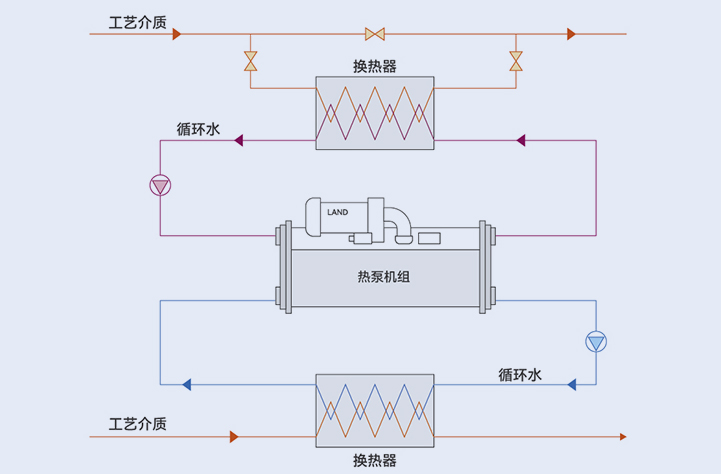
The evaporator side of the heat pump unit exchanges heat with the low-temperature end of the process through circulating water, absorbing waste heat at low temperature and enabling the heat pump working medium to complete phase change, thus achieving waste heat extraction. The heat is then upgraded in temperature after being processed by the compressor, converting low-grade heat sources into high-grade thermal energy that meets the process heating requirements. The condenser side exchanges heat with the process heating end through circulating water, releasing the upgraded heat to the process side for process heating.
The heat pump unit operates independently from the process flow, allowing for flexible equipment layout and suitable for energy-saving retrofits of existing devices. Heat transfer is achieved through a circulating water intermediate medium, ensuring no interference between the heat pump system and the process side, and good operational isolation. It is suitable for scenarios where the process low-temperature end and heating end are far apart, or where the retrofitting space on the process side is limited. The heat pump unit and the process system operate independently, offering flexible operation and adjustment, facilitating later maintenance and management.
System objectives:
The core components of the heat pump are directly integrated with the main process flow, embedded into the heat extraction at the low-temperature end of the process and the heat supply at the heating end of the process, reducing intermediate heat exchange links and temperature difference losses, and achieving efficient heat recovery and cascade utilization.
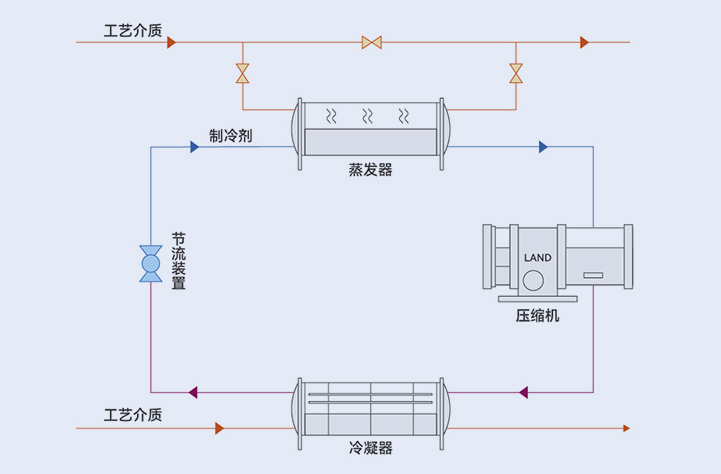
The heat exchanger at the low-temperature end of the process directly serves as a heat pump evaporator. The heat pump working fluid absorbs waste heat at low temperature and completes phase change, achieving efficient extraction of waste heat. The heat is then upgraded in temperature after doing work through a Land compressor, transforming low-grade heat sources into high-grade thermal energy that meets the needs of the process heating end. The heat exchanger at the process heating end directly serves as a heat pump condenser. The heat pump working fluid releases heat for condensation, and the upgraded heat is directly reused in the process heating stage.
The heat pump system is directly integrated into the process flow, reducing intermediate media and secondary heat exchange steps, resulting in a shorter heat exchange circuit and lower temperature difference losses. The system can fully recover heat from the low-temperature end of the process and reuse it for the process heating end, effectively reducing external steam consumption and cooling load. There is no need for additional complex circulating water heat exchange pipelines, leading to higher equipment integration and a more compact system structure. The heat supply is deeply coupled with the main process flow, facilitating continuous, stable, and efficient operation of the device.
Embedded heat pump coupling technology is applicable to various process scenarios such as chemical engineering, fine chemicals, pharmaceuticals, and solvent recovery, and can provide enterprises with comprehensive energy-saving solutions that balance energy conservation and consumption reduction, cost reduction and efficiency improvement, system optimization, and green and low-carbon development.
Yantai Land Air Conditioning Industry Co., Ltd.
No. 3, Land Road, Laishan District, Yantai City, Shandong Province
400-6582531
Follow The Platform

WeChat Official Account

Video Channel

Douyin account