The core of converting stable low-grade heat sources such as effluent/reclaimed water from urban sewage plants into heating capacity lies in transforming dirty water into a clean heat source that can operate for a long time.



The core of converting stable low-grade heat sources such as effluent/reclaimed water from urban sewage plants into heating capacity lies in transforming dirty water into a clean heat source that can operate for a long time.

The heating end is usually connected to the municipal heating network or regional heating system, and has extremely high requirements for the stability of the heat source and the continuity of heating. The system needs to have the ability to operate reliably and continuously.

Such water sources often contain impurities such as suspended solids, oils, fibers, and microorganisms, which can easily cause equipment fouling, scaling, and corrosion issues. Many projects have suffered from short equipment lifespan and frequent maintenance due to the failure to effectively address the impact of water quality.

The effluent from sewage plants, reclaimed water reuse, and urban drainage exhibit characteristics of relatively stable temperature throughout the year and considerable heat capacity, making them highly valuable low-grade heat sources for development.
System objective:
Turn sewage into a clean heat source to provide a qualified and stable heat source for the heat pump system.
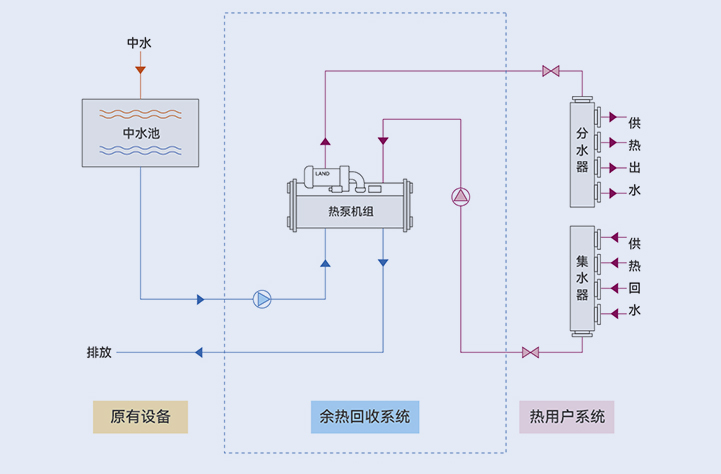
Pre-treatment for heat extraction on sewage/reclaimed water side
The key to dirty water purification lies in the front-end pretreatment, where a multi-level pretreatment system comprising grating, filtration, grit removal, and oil removal is established, coupled with anti-blocking design, to intercept pollutants at the source, reduce the pollution load on the subsequent heat exchange system, and ensure long-term stable operation of the equipment.
Heat exchange isolation
To avoid damage to the core equipment of the heat pump caused by sewage, an intermediate cleaning loop isolation system is installed, and an indirect heat exchange mode of "sewage-intermediate medium-heat pump" is adopted. This can significantly reduce the risk of equipment corrosion and scaling, ensuring stable operation.
Operations Management
The Land heat pump raises the temperature of low-grade heat in the intermediate circuit to the heating standard and integrates it into the municipal/park heat network. A full-process operation and maintenance system is established, equipped with cleaning and maintenance switching functions, real-time monitoring of key parameters, and risk prediction; regular cleaning is combined to maintain heat exchange efficiency and equipment lifespan.
Yantai Land Air Conditioning Industry Co., Ltd.
No. 3, Land Road, Laishan District, Yantai City, Shandong Province
400-6582531
Follow The Platform

WeChat Official Account

Video Channel
Douyin account