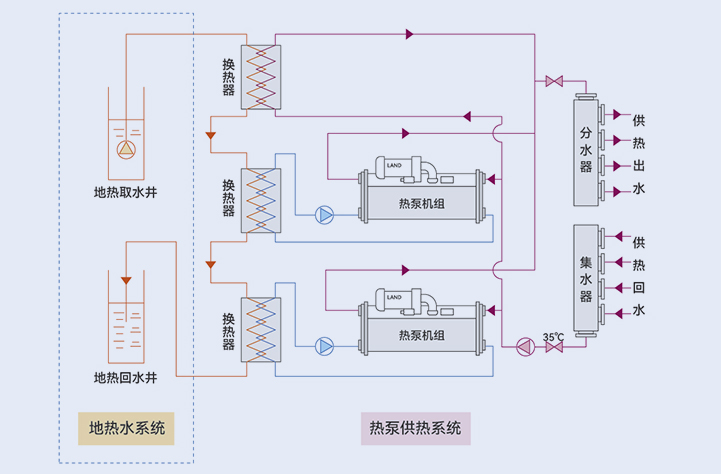
The cascade heat exchange system, utilizing a "plate heat exchanger + Land high-temperature centrifugal heat pump", enables the "exhaustive utilization" of geothermal resources and expands the heating capacity.



The cascade heat exchange system, utilizing a "plate heat exchanger + Land high-temperature centrifugal heat pump", enables the "exhaustive utilization" of geothermal resources and expands the heating capacity.

Geothermal water generally has high mineralization, strong corrosivity, and is prone to scaling. Scaling can significantly increase energy consumption, reduce heat transfer efficiency, and shorten equipment life. At the same time, environmental protection and recharge constraints are becoming stricter, requiring the implementation of measures such as equal recharge in the same layer. The anti-blocking, pressure difference management, and monitoring requirements of the recharge system are extremely high.

The current heating capacity is limited by the degree of matching between the effective heat of geothermal wells and the demand of the heating network. Traditional expansion requires the drilling of new wells, which not only incurs high drilling and equipment costs but also necessitates dealing with stringent approval and exploration processes, imposing dual pressures that hinder development.

The water temperature of geothermal wells is relatively high. Traditional heating methods only extract a portion of high-grade heat and then discharge or recharge it, leaving the tail water containing a large amount of low-grade heat that can be utilized, resulting in resource waste. This extensive utilization wastes the advantage of geothermal energy, which is abundant and stable, and fails to fully tap into its potential for energy conservation.
System objective:
Following the principle of "first using high-grade geothermal water directly, and then extracting the remaining water with a heat pump", the cascade heat exchange system consisting of "plate heat exchanger + Land high-temperature centrifugal heat pump" maximizes the energy efficiency of geothermal resources, achieving both the expansion of heating scale and meeting environmental protection constraints.
Primary utilization: direct supply of high-grade heat
Using plate or shell-and-tube heat exchangers, we prioritize extracting high-grade heat from geothermal water, which is then coupled with the return water side of the heating network to directly meet the needs of the heating temperature zone and enhance the primary heat exchange efficiency.
Multi-level utilization: Extracting waste heat from tail water using a heat pump
The tail water after primary heat exchange undergoes secondary heat exchange with the water on the heat pump evaporator side through an intermediate circuit, isolating geothermal water from the heat pump system and avoiding damage to equipment caused by corrosion and scaling. The heat pump extracts low-grade waste heat from the tail water, converts it into high-grade heat, and integrates it into the heating system. A multi-unit segmented operation mode is adopted to adapt to dynamic changes in the return water temperature of the heat network, ensuring stable waste heat extraction efficiency.
Key engineering points
Develop anti-scaling and anti-corrosion measures as well as online cleaning plans for the geothermal water side; consider "dirt blockage margin" when selecting heat exchangers; manage the recharge system and the main heating system separately to avoid mutual interference.
Yantai Land Air Conditioning Industry Co., Ltd.
No. 3, Land Road, Laishan District, Yantai City, Shandong Province
400-6582531
Follow The Platform

WeChat Official Account

Video Channel

Douyin account